 Dydxexchange
 offers perpetual and spot trading with fills shaped by available liquidity
Dydxexchange combines dYdX Chain perpetual contracts with Solana spot trading through a shared interface and separate trading systems. Perpetuals provide long or short price exposure without a scheduled expiry, using USDC collateral and an order book. Spot trading buys or sells tokens directly on Solana. Available liquidity governs execution prices and fill sizes. Leverage amplifies perpetual gains and losses relative to collateral. The products also differ in their access, funding and settlement rules.
dYdX Chain Contracts and Solana Spot Trades
The interface separates leveraged perpetual positions from direct Solana token trades, so the selected product determines the account balance and execution mechanism.
Perpetual Positions
A perpetual contract tracks an underlying market without transferring its tokens to the position holder. Traders can take long or short exposure, then reduce or close that exposure through matching trades. USDC supports collateral and settlement on dYdX Chain. The chain uses the Cosmos SDK and CometBFT consensus, with network nodes maintaining the order book. The chain has also hosted event-based prediction markets with governance-controlled final settlement.
Solana Token Trading
Solana spot trading launched on December 11, 2025, alongside the perpetual interface. Spot trades execute on Solana and exchange actual tokens. Spot token balances serve a different purpose from the USDC that backs perpetual positions. Perpetual funding and margin rules apply to contract positions, while spot transactions follow their Solana execution route.
Order-Book Depth and Execution Prices
The perpetual order book displays buy and sell interest at different prices, making available size part of an execution quote. A market order can match several price levels when the best quote lacks sufficient quantity. The spread measures the gap between the best bid and ask; depth describes liquidity beyond them. Prices and quantities can change before execution. The oracle price supplies a separate valuation reference, so a displayed reference price does not promise a fill at that price.
How Do Perpetual Order Types Change Execution?
Perpetual order types control eligible fill prices and whether an order matches immediately, waits on the book or activates after a price trigger.
Market and Limit Orders
Frontend market orders use Immediate-or-Cancel execution by default. They match available eligible liquidity and cancel any unfilled remainder. A limit order specifies the highest acceptable buying price or lowest acceptable selling price. It can execute immediately when suitable quotes exist, or remain open under a resting-order policy. Neither order type guarantees that the entire requested quantity will fill.
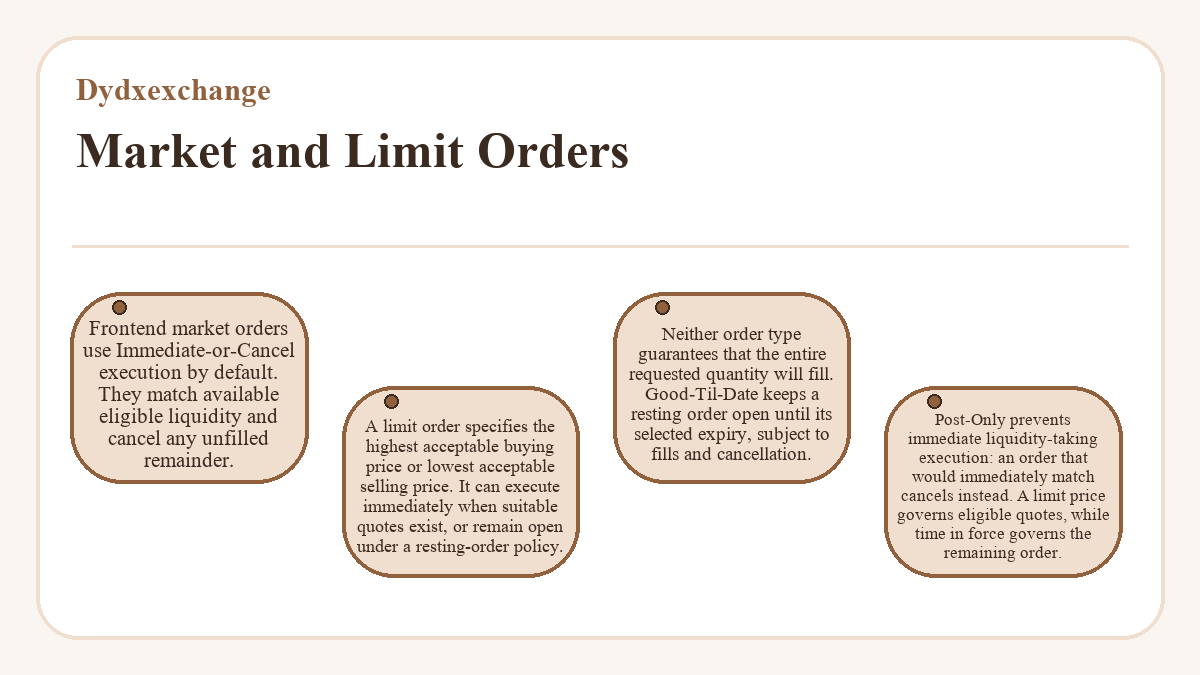
Good-Til-Date keeps a resting order open until its selected expiry, subject to fills and cancellation. Post-Only prevents immediate liquidity-taking execution: an order that would immediately match cancels instead. A limit price governs eligible quotes, while time in force governs the remaining order.
Triggers and Position Controls
Stop and take-profit orders activate when their price condition triggers. Market forms then seek execution against eligible liquidity; limit forms retain their specified price restriction. Triggering does not fix the eventual execution price. A stop-limit order can remain unfilled when the book has no quote within its limit, leaving the associated exposure open despite the trigger.
Reduce-Only restricts an order to decreasing an existing position. The frontend requires Immediate-or-Cancel execution for this option. Separately, the v9.0 software adds time-weighted average price (TWAP) orders for execution at scheduled intervals. Those executions use market prices and available liquidity; scheduling does not establish a fixed average fill price.
Partial Fills at a Price Limit
A smaller fill can follow a selected price limit even when more liquidity remains at higher prices. Consider a selected perpetual market with these hypothetical inputs: a buy order for 17.5 base units with a 48.65 USDC limit price per unit. The book offers 12.5 units at 48.65 USDC and another 5 units at 48.90 USDC. Assume valid market increments, sufficient collateral and no competing trades during matching.
The order fills 12.5 units because the higher-priced offers exceed its limit. The executed notional equals 12.5 × 48.65 = 608.125 USDC. This amount measures contract exposure at the fill price; the margin rules determine the collateral requirement. It is not a transfer of underlying tokens into a spot balance.
A Good-Til-Date order can leave the remaining 5 units open until matching, cancellation or expiry. An Immediate-or-Cancel order cancels that remainder. Changing the limit can change which quotes qualify, while changing time in force changes whether unfilled quantity stays open.
Margin Requirements and Leverage
Leverage compares notional exposure with the equity backing a position or margin account. Equity incorporates unrealized profit or loss along with the collateral balance. Initial margin sets the collateral needed to open or increase exposure. For a single position, its requirement equals absolute position size multiplied by the oracle price and applicable initial margin fraction. Maintenance margin uses the same valuation with the maintenance fraction. Free collateral equals equity minus total initial margin requirements. The effective initial margin fraction can rise with market-wide open interest, reducing available leverage.
Cross margin shares collateral across positions within a trading subaccount, so losses on one position can weaken the backing for others. Isolated margin assigns collateral to a particular position. Isolated markets require segregated collateral and have their own insurance funds. The web interface can also isolate positions in cross-marginable markets through separate subaccounts.
A trading subaccount becomes eligible for liquidation when its equity falls below its maintenance margin requirement. The liquidation engine attempts to close positions against order-book liquidity and may close them partly or fully. Rapid price changes can make a trading subaccount’s equity negative before liquidation completes. Contract-loss deleveraging can then reduce offsetting positions, including positions in adequately collateralized subaccounts.
What Costs Affect a Perpetual Position?
A perpetual position’s costs include trading fees and funding payments, while moving collateral can add network or route charges. Under the default dYdX Chain model, liquidation can also incur a penalty paid to the insurance fund. Trading fees use the executed notional and applicable maker or taker rate. Adding liquidity and removing liquidity receive different fee treatment. A limit order can take liquidity when it crosses existing quotes. The default taker-fee tier uses trailing 30-day trading volume; the current schedule and account tier determine the applicable rate.
Funding transfers value between long and short positions and can either reduce or increase an account balance. Positive rates charge longs and credit shorts; negative rates reverse that direction. The calculation reflects the perpetual market’s premium and applicable protocol settings. Funding rates can change while a position remains open, so accumulated funding belongs alongside trading profit or loss. The account’s funding history records settled payments rather than a forecast.
Solana spot costs follow a separate execution route. Network charges and fees that liquidity pools or launchpads impose can apply to a transaction. The perpetual fee tier does not determine those spot charges.
Wallet Access and Collateral Transfers
The web interface supports connected wallets and social login, with deposit choices varying by integration and network. Compatible EVM, Solana and Cosmos wallets provide different connection paths. Perpetual trading requires USDC in a trading subaccount. The main chain account holds assets for transfers and transaction gas, while subaccounts hold the collateral and positions used for trading. Connecting a wallet establishes account access; it does not supply trading collateral.
Perpetual deposits support integrated routes from supported source chains, exchange funding and direct supported USDC transfers. The Cosmos funding route uses USDC on Noble, and Inter-Blockchain Communication (IBC) carries transfers between compatible chains. The social-login deposit flow includes Coinbase funding and direct Noble USDC deposits. Wallet-based routes can offer additional source-chain choices. Funds can reach Noble before they appear as collateral in the trading subaccount.
Withdrawals must preserve the margin requirements that support any remaining positions. The destination network and selected route affect charges and completion time. Protocol withdrawal rate limits and safety restrictions can also delay a transfer. Public account addresses identify balances and trading activity through chain and indexer data. Developer APIs expose this market and account data to applications. The private keys or recovery phrase control access to those assets, making disclosure of that information an account-control risk.
MegaVault, Market Listings and dYdX
MegaVault supplies automated market liquidity, while the native DYDX token supports network staking and governance. These functions involve different balances and risks from an individual perpetual position.
MegaVault Liquidity
MegaVault uses deposited USDC to run automated trading strategies across dYdX markets. Its value reflects position profit or loss, funding payments, protocol fee revenue sharing and other community incentives. It can trade illiquid markets and lose value. An operator oversees market allocation and adjusts strategy parameters. Those choices affect which markets receive funds and which positions the vault holds. Removing funds can incur a charge when the withdrawal increases vault leverage. Deposits also reduce the USDC available for cross-margin trading, which can increase margin usage on existing positions.
Eligible Market Listings
Instant listings apply to markets that qualify as launchable. The default listing rules described in April 2026 required 10,000 USDC in MegaVault, locked for 2,592,000 protocol blocks. The 30-day estimate assumed one-second block times, so a slower chain extended the lock. Governance can change these requirements, and locked funds retain exposure to vault gains and losses. MegaVault allocations can change after launch, so the initial deposit does not establish permanent order-book depth.
Network Staking and Governance
Holders of native dYdX can delegate stake to validators and participate in dYdX Chain governance. Voting weight derives from actively staked tokens. Governance can change market parameters, community spending and chain software. Validator performance and commissions affect staking rewards. Unstaking follows the network’s configured unbonding period, so a staked balance has different availability from trading collateral.
Who Can Access Each Trading Product?
Eligibility differs between spot trading and perpetuals, with geographic restrictions applying to the particular product and frontend. The December 2025 Solana spot rollout included U.S. access; that launch did not open perpetual trading there. Perpetual frontend restrictions include the United States, Canada, United Kingdom and other prohibited jurisdictions. Spot availability consequently does not establish eligibility for leveraged contracts, MegaVault participation or market listings.
The perpetual frontend can place a flagged wallet in close-only mode, allowing order cancellation, position reductions and withdrawals. It disables deposits, transfers and new positions. Under the April 2026 frontend policy, seven consecutive days in close-only mode triggered blocked status. Blocking ended trading and withdrawal access through that frontend, while recovery-phrase export remained available. These restrictions concern interface access and must remain distinct from the protocol’s margin and withdrawal rules.
Ethereum History and the v3 Sunset
Earlier Ethereum products included spot trading, margin trading and lending. The Ethereum-based v3 service later provided perpetual trading. Trading on dYdX v3 ended in 2024. That shutdown concerned v3 and did not discontinue dYdX Chain. Residual v3 USDC remains in the retired Ethereum contracts, rather than the newer trading account. The corresponding withdrawal mechanism is the Escape Hatch.
Everyday questions about Dydxexchange
Does Canceling an Unfilled Order on Dydxexchange Incur a Trading Fee?
Canceling an unfilled perpetual order adds no trading fee under the default dYdX Chain fee model. Any portion that already filled remains a completed trade with its applicable fee. Canceling the remainder does not reverse that execution or its cost. This rule concerns the trading fee and does not establish that every unrelated on-chain transaction is free.
Why Can an Isolated Limit Order Reserve Collateral Before a Position Opens?
An unfilled isolated order can reserve collateral for a position that has not opened yet. The frontend allocates margin to the associated isolated subaccount before matching. Canceling every order for that unopened isolated position allows the frontend to return its collateral to the cross account. Canceling only one order may leave collateral allocated while other orders for that market remain open.
Are the Spot and Perpetual Deposit Addresses Interchangeable?
Spot and perpetual deposit addresses serve different trading balances and must match the intended product and network. The interface distinguishes the Spot address from the dYdX Chain address used for perpetuals. A connected wallet can expose both addresses without merging their balances. Funding the spot address does not itself credit the perpetual trading subaccount.
What Limits the Number of Open Perpetual Orders on an Account?
Equity tiers limit how many open orders a trading subaccount can hold. Isolated positions face their own subaccount equity checks, so total funds elsewhere in the account may not satisfy those requirements. Separate rate limits constrain order-placement activity within block windows. The interface can reject an order under either rule: open-order limits apply per subaccount, while submission-rate limits apply across the account’s subaccounts.
How Can Applications Read dYdX Market Data Without Placing Trades?
Applications can read market and account data through the Indexer API without submitting trading orders. REST endpoints provide queries, while WebSocket feeds deliver updates such as order-book changes and account activity. The indexer reads network data and serves it to applications. Executing trades uses the separate order-submission and authorization mechanisms; a data subscription grants no authority over an account.
Will a Perpetual Market Remain Tradable Indefinitely?
A perpetual contract’s lack of a scheduled expiry does not prevent governance from winding down its market. An approved wind-down cancels open orders, blocks new trading and closes positions through final settlement. The interface records those closures as Final Settlement. Historical fills can remain visible after the market stops trading, so a history entry does not establish current availability.
Updated