 Dydxexchange
 Dydxexchange staking connects native dYdX delegation with USDC rewards after validator commission
Dydxexchange staking rewards come from the fee revenue allocated to active dYdX Chain validators, less each validator’s commission. Native DYDX holders delegate tokens to a validator and receive rewards according to their staking share. The gross allocation changes with protocol revenue, governance-controlled distributions and the amount of bonded stake. Commission reduces the rewards allocated to a delegation, rather than its DYDX principal. A reward claim releases accrued funds without ending the delegation. Unbonding bonded DYDX starts a separate waiting period before the principal becomes transferable. These distinctions explain why a quoted return, a claimable reward balance and an available DYDX balance can show different amounts.
Table of contents
Native dYdX Delegation
Delegating native dYdX to an active validator supports dYdX Chain’s proof-of-stake consensus and makes the delegation eligible for staking rewards. The tokens must exist as native dYdX on dYdX Chain. A USDC trading balance does not substitute for the staking token, even though USDC supplies the main reward currency.
The Bonded Balance
A staking delegation records the relationship between a token holder’s address and a particular validator. Bonded tokens contribute to that validator’s stake weight and remain unavailable for ordinary transfers. The delegator does not need to operate a validator node to participate. The staking module tracks the delegation separately from the account’s unstaked tokens, so an account’s total dYdX can exceed its immediately transferable balance.
Active Validator Status
The active validator set determines which operators participate in consensus and receive staking rewards. Stake from delegators and the validator’s own delegation contributes to its ranking. A registered validator can accept delegations without entering the active set. An accepted delegation therefore establishes the staking relationship, while the validator’s active status establishes reward eligibility. That status can change as stake rankings or operational conditions change. A validator’s registration, commission rate and active-set membership describe different properties; a low commission does not make an inactive delegation earn rewards.
Fee Revenue and Validator Commission
Trading fees contribute USDC to the staking reward pool. Governance can allocate protocol revenue to other recipients, including token buybacks. The reward pool available to validators therefore need not equal all fees paid by traders. Revenue routing affects the amount available before any individual validator deducts commission.
The distribution mechanism allocates rewards by stake weight and accounts for each delegation’s share within its validator’s pool. With distributable revenue unchanged, more total bonded stake reduces the share attributable to an unchanged delegation. Changes in trading activity and revenue allocations also affect the gross share. An annualized staking estimate extrapolates those changing inputs; it does not establish a fixed payment schedule.
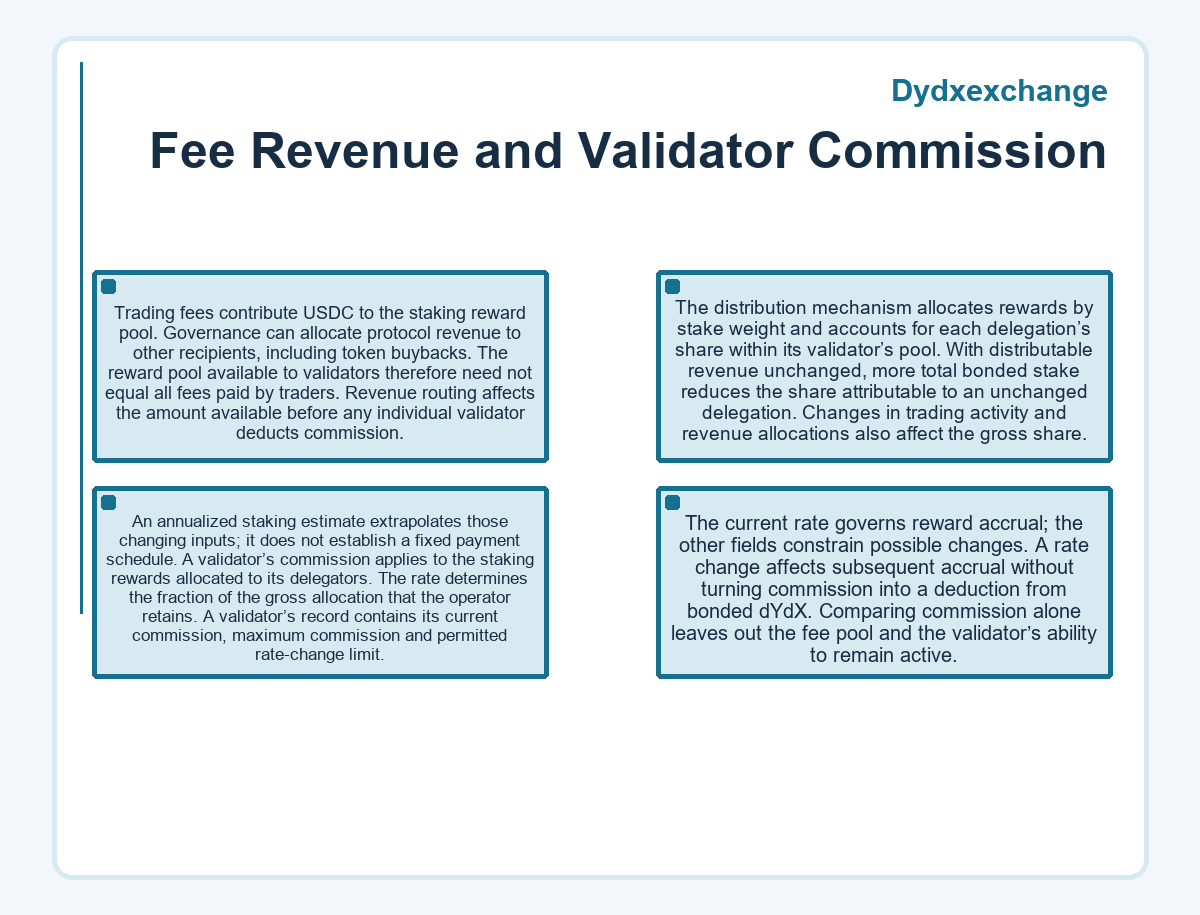
A validator’s commission applies to the staking rewards allocated to its delegators. The rate determines the fraction of the gross allocation that the operator retains.
A validator’s record contains its current commission, maximum commission and permitted rate-change limit. The current rate governs reward accrual; the other fields constrain possible changes. A rate change affects subsequent accrual without turning commission into a deduction from bonded dYdX. Comparing commission alone leaves out the fee pool and the validator’s ability to remain active.
Gross and Net Reward Arithmetic
Commission calculations use a reward allocation for a given period, so a stake amount alone cannot determine the USDC that a delegation earns.
A Hypothetical USDC Allocation
A delegator wants to translate a gross reward estimate into the amount left after commission. In this hypothetical calculation, the delegation’s gross allocation is 18.7 USDC and the selected validator’s commission is 7%. The gross allocation already accounts for protocol revenue routing and the delegation’s stake share.
The validator’s commission is 18.7 multiplied by 0.07, which equals 1.309 USDC. Subtracting that commission leaves 17.391 USDC for the delegation, before any cost of claiming the reward.
The calculation applies to a gross allocation. If a claimable balance already represents those 17.391 USDC after commission, subtracting commission again would understate that balance.
The retained amount holds only for the stated allocation and commission rate. Different revenue or stake-share inputs change the gross allocation, while a different commission changes the fraction retained. This calculation describes a reward allocation without projecting an annual yield.
Accrued Rewards and Claim Costs
Accrued rewards remain separate from bonded dYdX until a reward withdrawal releases the available funds. USDC rewards and the staked principal therefore represent different assets and accounting balances.
The Claimable Balance
The dYdX Chain interface offers a claim action when USDC rewards are available. Its claim flow requires the reward amount to exceed the gas cost needed for the claim. That condition belongs to this interface; the distribution module can track accrued amounts before the interface permits a withdrawal. Validator commission and claim transaction fees apply at different stages. Commission reduces the reward allocation, whereas the claim fee pays for the withdrawal transaction. Claiming earned USDC does not unbond the staked dYdX or start its exit period.
Reward Assets and Restaking
Trading fees supply USDC rewards. Transaction fees denominated in USDC or dYdX can also contribute to the fee pool. Native staking does not automatically add either reward balance to the bonded principal. USDC cannot directly become a dYdX delegation because the staking module requires its native staking token. Additional native dYdX requires a delegation to increase bonded stake. A payout in USDC therefore has different reinvestment mechanics from a reward paid in the staking token.
Validator Downtime and Redelegation
Validator reliability affects whether a delegation continues earning its share of protocol rewards. Delegations to validators outside the active set do not earn staking rewards. The delegation can remain recorded even while its validator no longer participates in consensus.
Downtime can trigger jailing and interrupt rewards. Whether a fault also reduces delegated principal depends on the applicable slashing parameters. Missed rewards and a principal deduction represent different outcomes.
Redelegation moves stake from one validator to another without first making the tokens transferable. An eligible move keeps the tokens staked and makes future rewards depend on the destination validator’s status and commission. The staking module restricts a delegator’s next move from a destination while that delegator has an immature incoming redelegation there. These restrictions prevent repeated moves from bypassing the period during which validator faults can remain relevant.
A completed move does not immediately erase liability for qualifying faults committed by the source validator before redelegation. That exposure continues during the applicable redelegation window when the slashing rules impose a penalty. Redelegation changes the operator supporting the stake; unbonding serves the separate purpose of returning transferable dYdX.
Unbonding and Available dYdX
Unbonding a bonded delegation removes the selected dYdX from reward-earning stake and starts the wait for its release. The chain records a completion time for the accepted unbonding entry. That timing governs the locked amount, even when an account screen includes it in a total token balance. The dYdX Foundation’s validator FAQ describes immediate undelegation from fully unbonded validators. The SDK selected by the dYdX Chain repository instead creates a timed unbonding entry for accepted undelegations, including from fully unbonded validators. An inactive label alone does not establish immediate release.
Partial unbonding leaves the remaining eligible delegation in place, where it can continue accruing rewards. A waiting unbonding entry can remain exposed to penalties for qualifying faults that occurred while the tokens were bonded. Unstaking through the dYdX Chain interface automatically claims accrued USDC rewards from the selected validator, without accelerating the principal’s release. Once the chain completes the entry, the returned dYdX becomes available in the delegator’s account. The amount that needs to become transferable determines whether a partial or full unbonding fits the task.
Dydxexchange: what people ask
Does Earning dYdX Staking Rewards Require Trading Perpetual Contracts?
Earning validator staking rewards does not require opening a perpetual position. Eligibility comes from delegating native dYdX to an active dYdX Chain validator. Trading generates protocol fee revenue, but a delegator’s own trading activity does not establish the staking allocation. Trading incentives and validator staking rewards follow separate mechanisms.
Can a Validator Spend the dYdX That I Delegate?
A validator cannot spend delegated dYdX as its own wallet balance. Delegation assigns validation rights while the staking module holds the tokens. Transferring tokens to an operator’s personal address creates a different relationship. Protocol penalties remain a separate possibility under the applicable slashing rules.
How Does Delegating dYdX Affect My Governance Vote?
A delegator can cast a governance vote directly using the weight of dYdX delegated to active validators. Unstaked or unbonding dYdX does not contribute voting weight. When the delegator does not vote, the validator inherits the voting weight associated with that delegation. A direct delegator vote overrides the validator’s choice for that weight. The validator’s governance participation therefore matters separately from its commission and reward performance.
Are Ethereum-held ethDYDX Tokens Eligible for These Staking Rewards?
Ethereum-held ethDYDX does not itself create a dYdX Chain staking delegation. Native dYdX on dYdX Chain must support the validator delegation that earns these rewards. Support for the former migration bridge from Ethereum ended in June 2025. Older bridge-and-stake instructions therefore describe a route that no longer has that support.
Will USDC Rewards Prevent Losses If the Price of Staked dYdX Falls?
USDC rewards do not fix the market value of the staked dYdX. The principal remains denominated in dYdX, whose price can change while the tokens remain bonded or unbonding. Measuring a return in dollars therefore requires considering the principal’s changing value alongside rewards and transaction costs.
What Determines Commission When I Stake With Multiple Validators?
Each validator applies its own commission to the rewards attributable to your delegation to it. A combined reward total reflects those separate allocations after their respective deductions. An unweighted average of the commission rates does not determine the total retained reward, because delegation sizes and eligible reward allocations can differ between validators.
Updated